

When we think of obesity, our minds immediately go to the scale, calorie counting, or a purely metabolic issue. However, the scientific reality emerging from research laboratories tells a very different and far more complex story. Today we know that obesity is not simply an accumulation of fat, but a true immune-mediated disease. Within the adipose tissue of patients, a silent and constant condition develops, which scientists call meta-inflammation: a fire smoldering under the ashes, a chronic low-grade inflammatory state that, over time, becomes the primary culprit behind the most severe complications, such as type 2 diabetes, atherosclerosis, and cardiovascular diseases.

Understanding what lights this fuse and how to put it out is the real challenge of our time. This is where the IARM project (Interplay between Innate and Adaptive immunity: the role of CD300e Receptor in Monocytes) comes into play. Led by Professor Nagaja Capitani from the Department of Life Sciences at the University of Siena, and funded under our University’s New Frontiers 2025 scheme, this research allows us to explore a completely new frontier in immunometabolism. The project was born with the aim of shedding light on the molecular mechanisms that link the immune system to metabolic disorders, focusing on a very specific player: the CD300e receptor.
“This receptor can be imagined as a sort of antenna located on the surface of certain immune cells”, explains the Professor, “specifically monocytes and macrophages, which represent the soldiers of our innate immunity—the body’s first line of defense. While adipose tissue lives in perfect balance in a healthy individual, in obesity, this antenna is tuned to maximum volume. Clinical data show that patients with obesity display extremely high levels of CD300e. What is extraordinary is that when these patients lose weight, for example after bariatric surgery, the expression of this receptor drops drastically, and metabolic health improves. There is, therefore, a direct and very close link between this molecule and the inflammatory storm“.
The core of the IARM project aims to decipher exactly what happens when this “antenna” is activated.
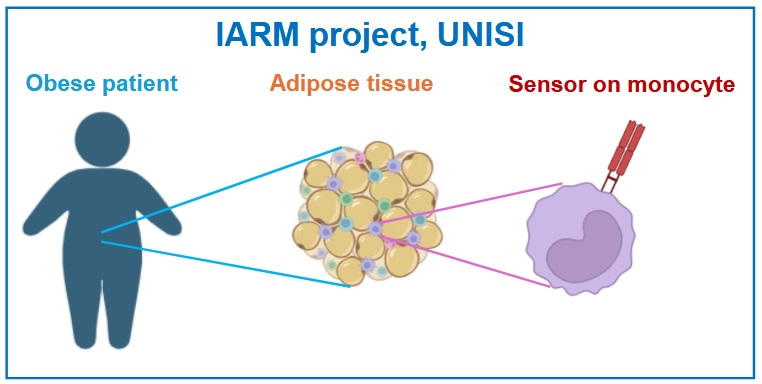 “Preliminary evidence indicates that the stimulation of CD300e forces monocytes to undergo a behavioral mutation”, continues the researcher, “they become hyperactive and aggressive, producing a massive amount of cytokines, the messengers of inflammation. Furthermore, these cells become insulin-resistant and tend to adhere more easily to blood vessel walls, laying the groundwork for the development of atherosclerosis”.
But the research goes even further, exploring the dialogue between innate and adaptive immunity, specifically how “hyper-activated” monocytes influence T lymphocytes, the most specialized guardians of the immune system, altering their ability to migrate and further amplifying tissue inflammation.
To map this faulty dialogue, the research will take place in the laboratories of the University of Siena, starting from cells purified from the blood of healthy donors. These cells will be exposed to stimuli that faithfully recreate the inflammatory microenvironment characteristic of obesity, integrating cellular, functional, and genetic data to trace every single biochemical signal.
The long-term goal is twofold: to validate the CD300e receptor as a biomarker, a warning light in the blood capable of signaling a patient’s risk of complications in advance, and to set the foundation for the development of targeted therapies.
“We envision smart drugs capable of selectively turning off this antenna, blocking inflammation at its root, restoring balance to the immune system, and drastically improving patients’ quality of life”, concludes Professor Capitani.