

Developing advanced organic materials capable of emitting circularly polarized light to ensure brighter displays and, at the same time, significant energy savings in electronic devices: this is the central objective of CCCP – “Coarse-Graining the Chiral Aggregation of Conjugated Polymers,” a project selected among the winners of the New Frontiers grant provided by the University of Siena to support the research activity of faculty under 45.

With funding of €20,000, the study led by Professor Daniele Padula of the Department of Biotechnology, Chemistry and Pharmacy aims to advance the field through computational modeling. The research focuses on studying the formation of self-assembled thin layers of organic materials capable of emitting circularly polarized light. Their use in devices such as OLED displays would make it possible to maintain the same brightness as conventional systems while drastically reducing battery consumption in portable devices and electricity use in household ones. In addition, the use of polymeric materials opens the way to producing displays of significantly larger size than those currently on the market.
“The goal of the project”, explains the professor, “is to produce a general model to study self-assembly of organic materials. Starting from detailed computer studies of some well-known polymers, we aim to abstract the chemical detail — atoms, bonds, electrons — using stylized shapes such as rods, disks, or spheres, in order to achieve generality. The key will be determining the interactions that lead to aggregation and translating them into adjustable parameters that allow thestylized objects to describe a wide range of substrates”.
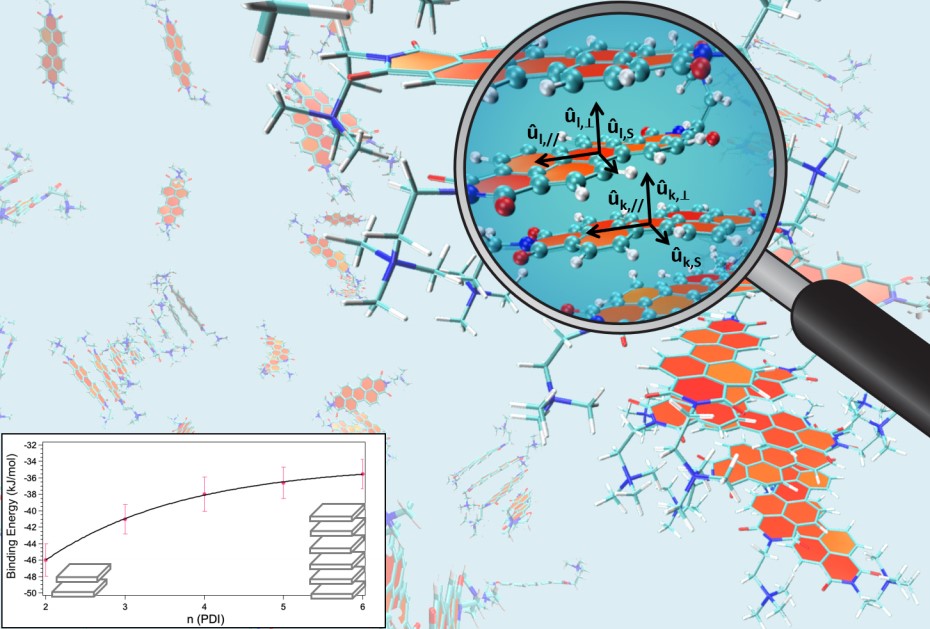
“In this way”, the researcher continues, “we can provide the optimal parameters for a target property, such as brightness or thermal stability, and propose new polymers before their synthesis, which will then be verified by colleagues in the laboratory”.
But why are these materials so promising for energy savings? The answer lies in a specific structural property: chirality. Examples of chiral objects are our hands, or a right-handed and a left- handed helix: they are mirror images but not superimposable.
The professor explains: “We will focus on aggregates with these characteristics because they are capable of emitting circularly polarized light, which can pass through the optical filters placed on every OLED device”.
Currently, much of the light emitted by devices is blocked by the filters needed to prevent optical contamination from reflected sunlight, resulting in sub-optimal power consumption. “With these special materials”, the professor concludes, “the light will be able to pass through completely, providing greater brightness at the same current or, if preferred, the same brightness with lower electrical consumption”.
The CCCP project also represents an important training opportunity. The university’s contribution has been used to fund two scholarships intended for students holding at least a bachelor’s degree in Chemical Sciences. The young researchers will have the opportunity to engage in the computer-based development of polymer models and participate in possible visits to collaborating research institutions, both in Italy and abroad.