

Can tardigrades, among nature’s most resilient organisms, help us safeguard the future of plant life against the challenges of an increasingly warmer planet and the new frontiers of space exploration?

The TRUST project (Translating Research for Universal Sustainability and Transparency) aims to answer this question responsibly and on firm scientific grounds, investigating how a microscopic survival strategy can be transformed into sustainable innovation for society as a whole. Led by Professor Silvia Cantara of the Department of Medical, Surgical and Neurosciences at the University of Siena, TRUST is supported by the University’s INTERDIX funding programme.
Tardigrades, microscopic animals also known as “water bears”, can tolerate dehydration, radiation, extreme temperatures and even the vacuum of space. Part of this extraordinary resilience is linked to Dsup, a protein capable of binding to DNA and protecting it from damage.
“We asked ourselves,” explains Professor Cantara, “whether this natural ‘molecular shield’ could offer us a new strategy to help plants cope with environmental stress.”
The technology developed at the University of Siena focuses on a key and extremely delicate stage: pollen.
“Our patented technology focuses on pollen, and this is a key choice,” the researcher explains. “Pollen is one of the most vulnerable stages of the plant reproductive cycle: if germination or pollen tube development fails, fertilisation may also fail, and the plant will not produce seeds or fruit. By working on pollen, we can study plant reproductive resilience in a rapid, measurable and contained system, without having to produce conventional GM plants intended for food use. We use it as a precise experimental platform to determine whether Dsup can support plant reproduction under stress conditions.”
The first steps in this direction have already produced extremely encouraging results: previous studies, published in the journal Cells in 2024, demonstrated that the expression of Dsup in tobacco pollen can mitigate some of the adverse effects of UV-B radiation, improving stress-response parameters and restoring important features such as pollen tube growth and the proper deposition of callose plugs.
“This is a promising starting point,” continues the professor, “but with TRUST we want to go further: we aim to identify the safest and most effective form of Dsup, including smaller functional domains, and test how transformed pollen responds to different stress conditions, such as UV radiation, oxidative stress, heat and microgravity.”
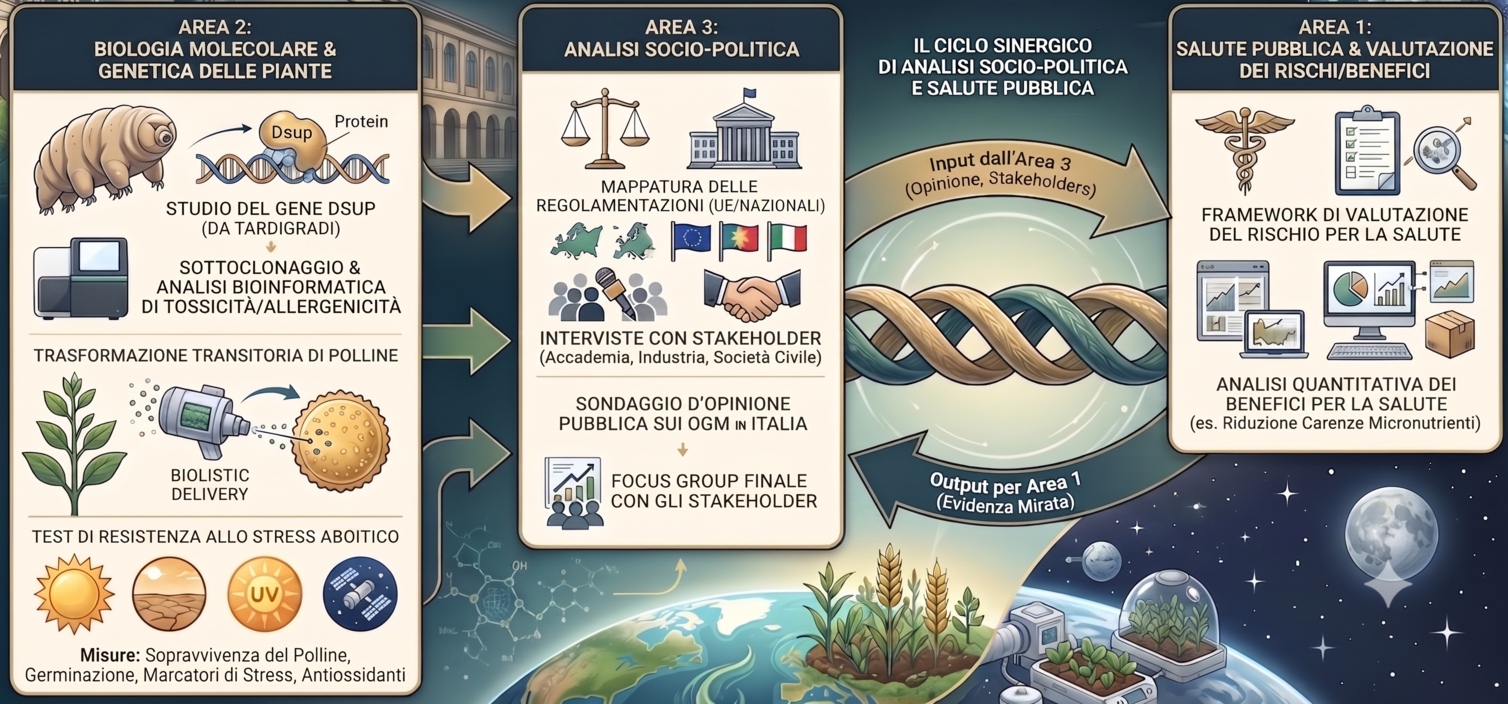
The ultimate goal of the biological work—which includes bioinformatic screening to assess potential allergenicity, molecular engineering of Dsup domains, pollen transformation, microscopy, proteomics and RNA sequencing—is not simply to demonstrate that a protein works, but to understand exactly how it works and how safe it may be with a view to possible future applications.
Technologies involving genetic modification raise not only scientific questions, but also social, ethical, legal and political ones. For this reason, TRUST adopts a “Quadruple Helix” approach, fostering continuous dialogue among academia, policymakers, industry and civil society.
If a technology is scientifically promising but society does not understand it, trust erodes. TRUST seeks to build a model in which laboratory data, safety assessment and dialogue with citizens advance hand in hand.

This vision of transparency and listening also frames the work carried out within the INTERDIX project. Coordinated by Professor Linda Basile and Dr Mateo Restrepo as part of the Political Methodology course, students enrolled in the master’s degree programmes in International Studies and Communication Strategies and Techniques actively contributed to developing a public opinion survey. Professor Daiana Bezzini, an expert in Hygiene and Public Health, will also contribute to the analysis and interpretation of the results. Her expertise will make it possible to examine the data from a public health perspective, exploring the role of scientific knowledge, risk perception and trust in institutions, and helping to develop appropriate communication strategies.
“This collaboration,” explains Silvia Cantara, “also represented an important learning opportunity for the students. Starting from a review of the literature on public opinion, their work helped identify several key dimensions of the often vague concept of ‘attitudes towards GMOs’: from perceived and actual knowledge, to willingness to purchase or consume GM foods, and trust in institutions and science.”
The survey, conducted by Dynata on a weighted sample of 1,280 Italians aged between 18 and 75, revealed a highly mixed picture. Knowledge of the subject still appears rather limited, with 64% of respondents reporting that they know little or nothing about GMOs. Misconceptions rooted in common belief also persist: for example, 68% believe that animals fed GM feed produce milk or eggs that are themselves genetically modified, while 61% are unaware that most soy grown worldwide is already genetically modified.
This scepticism is also reflected in a generally low willingness to consume GM foods, with an average score of just 3.3 on a scale from 0 to 10. However, distrust decreases markedly when products are presented in association with specific, tangible benefits, such as improved nutritional quality, lower pesticide residues, validation by independent authorities, or the use of technologies that act only at early stages without altering the final product.
The choice experiments involving everyday products such as pasta were also particularly interesting. When a packet of GM pasta is presented as less expensive, the probability that consumers will choose it rises from 11% to 37%, while associating it with an identity symbol such as the Italian flag almost doubles its appeal, although reactions vary across the ideological spectrum of respondents.
“These data,” the researcher emphasises, “confirm how important it is to accompany scientific research with serious efforts to listen, communicate and understand the social context. Perceptions of GMOs depend not only on the technical characteristics of the technology, but also on trust, knowledge, values, communication frames and expectations regarding tangible benefits. For this reason, in the TRUST project, the social dimension is not an optional add-on, but an integral part of the innovation process.”
The potential impact is broad. On Earth, climate change is increasing the frequency of heatwaves, droughts, floods and other abiotic stresses that reduce crop productivity. In space, future long-duration missions to the Moon or Mars will require food-production systems capable of operating in the presence of radiation, altered gravity and limited resources. In both contexts, protecting plant reproduction could become a crucial step towards more resilient agriculture.
“TRUST is not just about making plants stronger,” concludes Professor Cantara, “but about showing how science can transform a microscopic survival strategy into sustainable innovation for society. It concerns DNA protection, plant reproduction, adaptation to climate change and space agriculture, but above all it aims to strengthen trust—hence the name—between the research community and citizens.”